Understanding the relationship between consciousness, emotional states, perception, and personal transformation.
1. The central philosophy
In his book Power vs. Force, Dr. David R. Hawkins presents a model of human consciousness that organizes different states of awareness along a numerical scale from 1 to 1,000.
Hawkins proposes that consciousness can be understood through progressively higher states of awareness, ranging from shame, guilt, fear, and pride to courage, acceptance, love, peace, and enlightenment.
In his interpretation, lower states are associated with contraction, limitation, and ego-driven perception, while higher states represent greater openness, compassion, truth, and spiritual awareness.
His model offers a philosophical lens through which to explore how our internal experiences influence the way we perceive ourselves, interact with others, and navigate life.
Important distinction: Hawkins described his scale as a system of calibrated consciousness levels, using applied kinesiology as his proposed method. His numerical calibrations and claims about measurable energetic frequencies have not been scientifically validated as objective measurements of human consciousness or emotion.
2. The Map of Consciousness
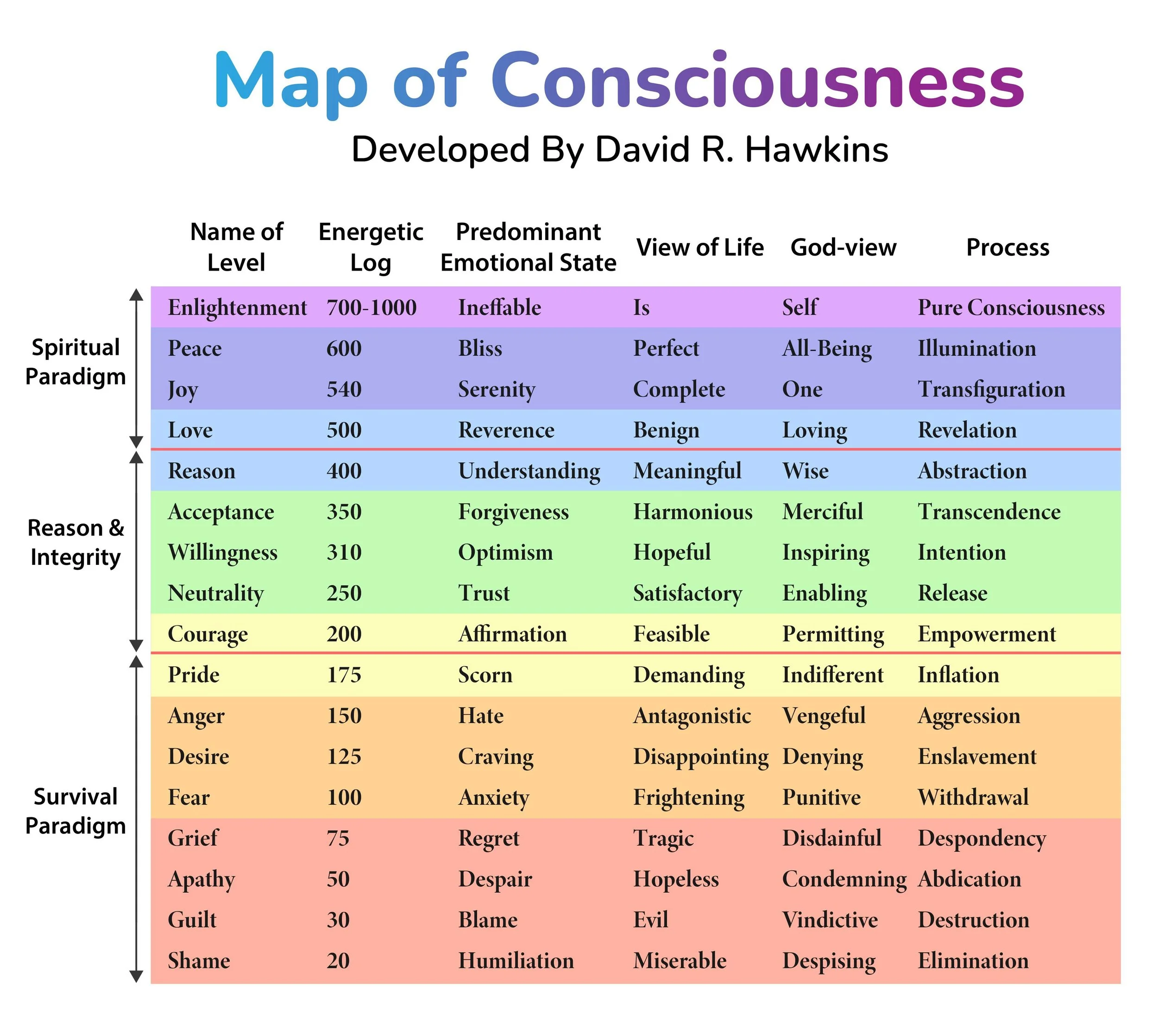
How to Measure Consciousness With the Map of Consciousness
The following levels reflect Hawkins' proposed classifications, not scientifically established emotional frequencies.
3. The significance of courage: 200
One of Hawkins' central distinctions is the level of 200, which he identifies as the threshold between destructive and constructive ways of experiencing life.
He describes courage as the point at which a person begins moving away from helplessness, blame, and victimhood toward responsibility, empowerment, and personal choice.
From a practical personal-development perspective, this is an especially valuable concept.
Consider the difference:
Fear says: I cannot.
Anger says: Someone else is responsible.
Pride says: I must protect my image.
Courage says: I am willing to face this.
Acceptance says: I can acknowledge what happened and decide what comes next.
The transition isn't about suppressing difficult emotions. It's about developing the awareness and capacity to respond differently.
4. Force versus power
This is one of the most interesting philosophical distinctions in Hawkins' work.
5. Releasing rather than resisting
Another important theme in Hawkins' philosophy is that personal transformation doesn't necessarily come from fighting unwanted emotions.
He suggests that awareness and the willingness to release emotional attachments allow consciousness to move toward higher states.
For practical application, this can mean:
Recognizing resentment instead of pretending it doesn't exist.
Understanding fear instead of allowing it to dictate decisions.
Identifying the beliefs behind recurring emotional reactions.
Releasing the need to control outcomes.
Taking responsibility for your own choices.
Developing the ability to respond rather than automatically react.
This also creates an opportunity to connect Hawkins' philosophy with cognitive behavioral principles: recognizing thought patterns, examining underlying beliefs, and developing healthier responses.
6. What this means in everyday life
The most useful application of the model isn't assigning yourself a number.
It's learning to recognize the internal patterns influencing your experience.
You cannot always control what happens to you, but you can develop greater awareness of how you interpret, experience, and respond to what happens.